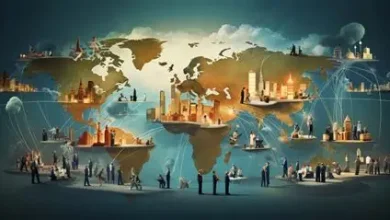
The contemporary economy is based on two interconnected pillars: banking and finance. While management of funds, investments and resources is a broad aspect of finance, banking is an infrastructure that makes these financial functions possible. Together, they form a framework that allows people to finance, companies and countries to move forward. Knowing how to negotiate banking and finance demonstrates their importance in determining global prosperity.
Understanding financial matters
The art and science of managing finances is known as finance. This risk includes aspects like administration, credit, savings, investment and budget. There are three stages of operations in finance:
Personal finance in which people manage their earnings, plans and savings.
Corporate finance is the study of capital structure, growth strategies, and firms.
Role of Banking
Banking acts as a conduit for the flow of money. Banks collect money from people and companies and use the funds to make loans, loans and mortgages. This technique provides the possibility of economic development in addition to the continuous transmission of money.

Banks provide important services to consumers, including online transfers, debit cards, and savings accounts. They provide treasury management, trade financing and loans to businesses. At the national level, central banks monitor inflation, administer monetary policy, and maintain the stability of the financial system.
Coordination between finance and banking
The banking and financial sectors are closely related. Banking applies these ideas to the actual category system, while financial models provide strategy and guiding principles. For example, how to calculate financial concepts related to risk management and interest rates, as well as how to develop bank lending policies and product design.
Technical change
Technology has once again affected the banking and financial industry in recent years. Financial services are now more accessible than ever with digital banking, smartphone wallets and internet commerce platforms. Fintech companies are boosting traditional banking by offering fast, less expensive and easy-to-use options.
The digital revolution has also improved financial inclusion. The smartphone has made it possible for people in faraway places, who did not have access to traditional banking, to save, borrow and invest in advance. Therefore, both serve as a tool to reduce the catalyst and inequality for banking and financial economic development.
final thoughts
A lifetime of economies are simultaneously manufactured by prohibition.
As globalization and technology advances, banking and finance will play an important role not only in determining the economy but also in setting accessible opportunities for people and communities globally.