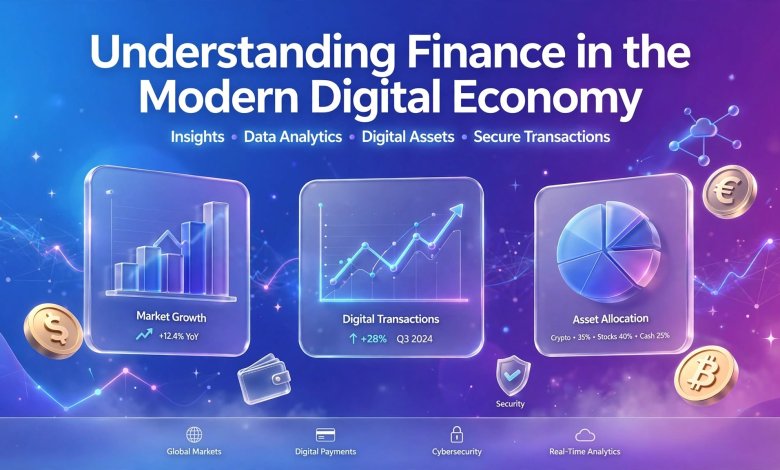
Finance is key within the digital world and enables both individuals and businesses to handle money and make well-informed decisions. Technology has revolutionised financial-related services, enabling people to bank, pay, invest and plan in an efficient way. People can now perform financial related tasks at speed and from most locations, using digital technology.
Evolving finance
Whilst in the past finance was largely associated with banks and involved paper and was labour intensive, recent years have seen the integration of technology which has made financial services more efficient. People are able to handle financial matters using digital technology including viewing and manipulating money and analysing expenditure. Overall, financial provision has therefore become both more accessible and efficient.
Digital Banking
Digital banking is now a crucial element of financial provision. People can bank, pay bills, move money and analyse past financial activity without needing to attend a physical bank. Banking apps can also alert people to banking related events and offer further banking functionality. Furthermore, digital banking enables firms to process payments in an efficient manner and efficiently store and analyse financial data, so facilitating more streamlined business functioning.
Financial technology
Fintech is a rapidly developing area of finance. Within this sector, novel financial products and services are produced such as digital money storage, online loans and payment methods together with financial planning tools. As well as offering modern and efficient financial provision, these services stimulate financial organisations into further enhancing customer experience and increasing efficiency within their services.
Digital and cashless payments
Digital and cashless payment options are redefining financial transactions. People can use a variety of different digital payment mechanisms including mobile money storage, debit cards, QR codes and internet based payment methods to swiftly make financial transactions. Cashless payment is also beneficial for firms as it allows them to effectively analyse financial data. To minimise the risk of fraudulent behaviour, individuals must ensure that they utilise secure digital payment services and confirm that financial transactions are valid.

Managing personal finance
Digital technology has facilitated easier financial handling. People can analyse their income and expenditure, store money and define financial aspirations via digital financial apps. These apps can also effectively analyse financial behaviour and highlight areas where expenditure may be superfluous. Maintaining good financial practise is still key to ensuring long term financial wellbeing.
Cyber security
With an increasing amount of financial provision being undertaken digitally, cyber security is a key area of interest. Financial issues can arise from digital fraud, identity theft and phishing and unauthorised financial transactions. Financial bodies implement security and transaction analysis procedures to safeguard customer financial data. Likewise, individuals must take care to construct strong passwords and apply two factor authentication. Furthermore, people should avoid disclosing sensitive financial information.
Artificial intelligence
Artificial intelligence is opening up fresh options within finance. AI is capable of analysing financial data and recognising atypical financial behaviour. It can also be utilised within customer service. Companies can benefit from incorporating AI into their financial decision making and risk analysis. Despite the numerous advantages that can arise from automating financial processes, human oversight and appropriate data handling is still vital.
Financial inclusion and business prospects
Within the digital economy, novel financial prospects are available for those who previously struggled to engage with conventional financial provision. Digital financial services such as digital banking and payment mechanisms can enable both individuals and small enterprises to engage with financial provision. In addition, entrepreneurs can harness digital financial services to process payments, engage with clients and control company financial data. Appropriate financial knowledge together with access to cost-effective technology are key to allowing people to effectively exploit financial prospects.
Securing a position within future digital finance
Future financial provision is set to become increasingly automated and benefit from enhanced payment and security procedures. Further, financial provision is likely to become more tailored. Continuing to build digital financial expertise will enable both people and businesses to recognise and comprehend emerging financial provision and associated risks. Remaining knowledgeable about financial technology, applying good financial practise and utilising trustworthy financial services can all assist in adapting to evolving economic circumstances.
Conclusion
Finance is continually evolving within the digital era, influencing how people work, spend, save and invest. Digital banking, fintech, artificial intelligence and cashless payments are all giving rise to fresh financial prospects for individuals and firms.Understanding these evolutions facilitates improved financial decision making and equips people to address forthcoming issues.

Integrating digital innovation alongside financial expertise, cyber security know-how and good financial practise can thus underpin enhanced long term financial success.
Thanks